





How Do Sinkholes Form?
Sinkholes are one of nature’s most fascinating and unpredictable geological phenomena. They can range from small, harmless depressions to massive collapses that cause significant damage to infrastructure and pose serious safety risks. Understanding how sinkholes form and the conditions that contribute to their development is essential for prevention and mitigation. Areas underlain by limestone or other soluble rocks are particularly vulnerable, making awareness of regional geology an important part of risk management.
In this article, we’ll explain what sinkholes are, how to recognize signs of one forming, the factors that cause them, and the different types that exist. We’ll also highlight some of the most well-known sinkholes in the United States, including notable examples that have experienced recurring activity.
What is a Sinkhole?
The U.S. Geological Survey (USGS) defines a sinkhole as a depression in the ground with no natural external surface drainage. When it rains, water collects inside the sinkhole and drains directly into the subsurface. Sinkholes most commonly occur in regions known as karst terrain, where porous bedrock, such as limestone, gypsum, or salt, gradually dissolves over time, creating underground voids that can lead to sudden ground collapses.
How Can You Know if You Have a Sinkhole?
There are several ways to recognize if a sinkhole may be forming on your property. Some signs can be subtle, while others are more obvious. Watch for the following indicators:
- Structural damage: Cracks in walls, floors, or ceilings.
- Doors and windows: Difficulty opening or closing them properly.
- Water issues: Cloudy, muddy, or unusually pooling water on your property.
- Ground changes: Previously buried fence posts, foundations, or other structures becoming exposed.
- Vegetation stress: Plants or grass that are withering, dying, or showing unusual patterns.
- Soil patterns: Circular cracks or depressions forming in the ground.
What Causes Sinkholes?
Sinkholes form when the ground beneath the surface becomes unstable and collapses, often without warning. The primary cause is the dissolution of soluble bedrock, such as limestone, gypsum, or salt, by naturally occurring water. Over time, rainwater and groundwater slowly erode the rock, creating underground cavities that can no longer support the weight of the soil and structures above.
Other contributing factors include:
- Natural erosion: Water moving through soil and rock can gradually remove support beneath the surface.
- Heavy rainfall or flooding: Excess water can accelerate the collapse of already weakened ground.
- Human activity: Construction, drilling, mining, or broken water and sewer lines can destabilize the soil and trigger sinkholes.
- Changes in groundwater levels: Rapid draining or pumping of groundwater can leave underground cavities unsupported.
Sinkholes can develop gradually or appear suddenly, depending on the size of the cavity and the stability of the surrounding soil. Understanding these causes is essential for identifying risk areas and taking preventive measures to protect property and safety.
What are the Different Types of Sinkholes?
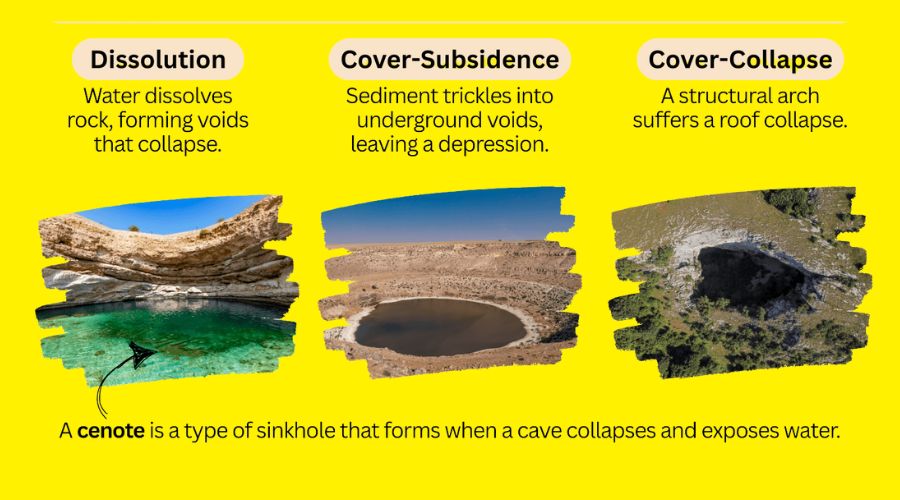
Not all sinkholes are the same. They are generally classified into three main types, each forming under different conditions at the ground surface. Of these, only one type typically results in catastrophic collapse. Here’s a closer look at each:
- Dissolution Sinkholes: These form when groundwater slowly dissolves soluble rock, such as limestone or dolomite, creating underground cavities. Over time, if the overlying soil can no longer support the weakened rock, the surface may gradually collapse.
- Cover-Subsidence Sinkholes: These occur when surface materials, like sand or soil, gradually fill voids in the underlying bedrock. This slow movement leads to depressions or minor collapses at the surface rather than sudden failures.
- Cover-Collapse Sinkholes: The most dangerous type, cover-collapse sinkholes can cause sudden and catastrophic damage. They develop when overlying soils contain a high percentage of clay. As the clay forms a “bridge” over an enlarging underground cavity, it can hold for some time, but once the bridge fails, the ground above can collapse rapidly and unexpectedly.
What are Some of the Most Famous Sinkholes in the United States?
Over the years, sinkholes have appeared across the United States. While some occur only once, others have experienced multiple episodes. Here are some of the most notable sinkholes:
The Devil’s Sinkhole, Texas
Located in Edwards County, this natural landmark features one of Texas’ largest single-chamber caverns. Its 50-foot-wide shaft drops 140 feet into a cavern over 320 feet in diameter and reaching a depth of 350 feet. Today, it is home to one of the largest colonies of Mexican free-tailed bats, making it a popular destination for bat watching. The site was designated a National Natural Landmark in 1971.
The Daisetta Sinkhole, Texas
This massive sinkhole appeared in 2008 in Daisetta, Texas. It spans 600 feet across and reaches a depth of 75 feet, making it one of the largest in the state.
The Winter Park Sinkhole, Florida
On May 8, 1981, a sinkhole opened in Winter Park, Florida. It measured 300 feet in diameter and 80 feet deep, drawing national attention for its size.
The Seffner Sinkhole, Florida
First appearing in 2013, this sinkhole tragically swallowed a man while he was sleeping. Local authorities have since managed the site with ongoing assessments and safety measures, including fencing and stability monitoring, to prevent further damage or accidents.
National Corvette Museum Sinkhole, Kentucky
In February 2014, a 20-foot-wide sinkhole opened beneath the National Corvette Museum in Bowling Green, Kentucky, swallowing eight display cars. Among them was the 1 millionth Corvette ever produced, one of the most valuable cars in the collection. The museum has since incorporated the sinkhole into its dome area, and its 2024 exhibit features two of the recovered Corvettes, including the milestone vehicle.
Protecting Your Property from Sinkhole Damage
Sinkholes are unpredictable and can cause significant damage to your home, property, and infrastructure. Even small sinkholes can lead to water intrusion, flooding, and structural instability. That’s why it’s essential to act quickly if you notice any signs of ground shifting, unusual water pooling, or structural cracks on your property. Learn more about handling basement flooding after a storm here
If your home or business experiences water or flood damage due to a sinkhole, or any other sudden event, professional water damage restoration services can make all the difference. Water and flood damage restoration experts assess the damage, remove excess water, dry affected areas, and repair structural issues to prevent long-term problems like mold, erosion, or foundation damage.
Don’t wait for a small problem to become a disaster. Contact experienced water and flood damage restoration professionals today to protect your property and restore your peace of mind. Prompt action can help minimize damage, keep your family safe, and ensure your property remains secure, even in areas prone to sinkholes.
Frequently Asked Questions
How long do sinkholes last?
The lifespan of a sinkhole varies depending on the type and the underlying geological conditions. Some sinkholes are temporary depressions that stabilize within a few weeks or months after water erosion stops, while others can grow and remain active for years or even decades.
- Dissolution sinkholes may expand slowly over many years as groundwater continues to erode the bedrock.
- Cover-collapse sinkholes often appear suddenly and may continue to expand over time if underlying cavities are not stabilized.
What to do if a sinkhole appears in your yard?
If a sinkhole suddenly forms in your yard, it’s important to act quickly to protect your property and ensure safety. Here’s what to do:
- Keep everyone away – Do not allow children, pets, or neighbors near the area. Sinkholes can expand suddenly and collapse without warning.
- Mark or fence off the area – Use cones, ropes, or temporary fencing to prevent accidental entry.
- Avoid water and heavy activity near the hole – Do not water the lawn, drive vehicles, or place heavy objects near the sinkhole, as this can worsen the collapse.
- Document the sinkhole – Take photos and note its size, shape, and any nearby structures or utilities that could be affected.
- Contact professionals – Call a licensed geotechnical engineer, foundation expert, or local authorities to inspect and assess the sinkhole.
- Check for property damage – Inspect nearby structures, underground utilities, and drainage systems for cracks, misalignment, or unusual water pooling.
- Consider insurance coverage – Review your homeowner’s insurance policy, as some policies cover sinkhole damage in certain states.

About Vince Sandri
Vince Sandri is a content writer and blogger with more than 12 years of experience. His expertise is in creating content related to disaster restoration, including information about preventing and reacting to natural disasters like flooding, water damage, fire and smoke damage, mold growth, storm damage and more.
Vince has been the main contributor to RestorationMasterFinder.com since 2014. Over that time, he has written numerous service pages and blogs for disaster restoration providers featured on RestorationMasterFinder.com. Vince has done extensive research and covered a wide range of topics relating to disaster restoration to help homeowners, business owners, and property managers better protect their property. He understands the problems that disasters like flooding, fire, smoke, and mold can cause as well as the best ways to respond to these issues to limit the damage.
Vince completed his Bachelor of Arts degree at Aurora University and his master’s degree at DePaul University. He has been writing SEO website pages, blogs, and press releases since 2012. Vince is also a musician and can be seen playing in the Chicago, IL area.